Tech
SBOM Vulnerability Analysis and the Parts Everyone Skips

Most security teams now have an SBOM Management Tool (SBOM) somewhere. Sometimes it sits in a folder attached to a procurement checklist. Sometimes it is generated automatically by a build pipeline and forgotten five minutes later. Either way, the presence of an SBOM alone does not reduce risk. What matters is the work that follows, and that work is messier than most vendor diagrams suggest.
SBOM vulnerability analysis is not a tooling problem. It is an operational one. It cuts across development, security and risk management in ways that are rarely comfortable. And when it fails, it usually fails quietly.
This blog talks about how SBOM vulnerability analysis actually plays out inside organisations that ship software, not how it is described in standards documents.
Why SBOMs Changed the Conversation but Not the Outcome
The push for SBOMs came from real pain. High profile supply chain incidents forced boards to ask questions about what was running inside their products. Regulators followed. Procurement teams followed after that.
The result was predictable. Organisations focused on generating SBOMs quickly, often by bolting scanners onto pipelines. Visibility improved on paper. The underlying exposure did not.
An SBOM tells you what components exist. It does not tell you whether they are reachable, exploitable, patched correctly, or even used. Vulnerability analysis is the missing layer, and it is where most teams slow down.
Not because they do not care. Because the reality is harder than the idea.
What SBOM Vulnerability Analysis Really Involves
At its core, SBOM vulnerability analysis is about translating component data into risk decisions. That sounds simple until you try to do it at scale.
A typical SBOM lists hundreds or thousands of dependencies. Many of them will have known CVEs. Some will be ancient. Others will be patched but misreported. A few will be critical and exposed. Most will sit in a grey area.
The uncomfortable truth is that vulnerability data is noisy. Context matters more than severity scores. Yet many organisations still treat SBOM vulnerability analysis as a filtering exercise driven by CVSS alone.
That approach collapses under pressure.
The Friction Points Teams Run Into
One problem appears almost immediately. Ownership.
Who is responsible for analysing vulnerabilities in third party components? Security teams often lack deep context about how code is used. Developers understand the code but are under delivery pressure. Product owners see risk in terms of deadlines, not libraries.
Without clear ownership, SBOM vulnerability analysis becomes performative. Reports are generated. Tickets are opened. Very little changes.
Another issue is timing. Vulnerability analysis is often triggered late, sometimes only after release. By then, fixing a dependency can mean breaking builds, revalidating integrations, or delaying customers. Risk acceptance starts to look attractive.
None of this shows up in glossy SBOM narratives.
A Practical Flow for SBOM Vulnerability Analysis

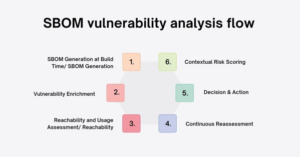
Below is the practical flow that vulnerability analysis follows:
1. SBOM Generation at Build Time/ SBOM Generation
The SBOM must reflect what is actually shipped, not what is declared. Build artefacts matter more than manifests.
2. Vulnerability Enrichment
Raw CVE data is pulled in but not trusted blindly. Source quality matters. False positives are expected.
3. Reachability and Usage Assessment/ Reachability
This is the step most teams skip. Is the vulnerable code path reachable in your implementation, or merely present?
4. Contextual Risk Scoring
Severity is adjusted based on exposure, privilege, deployment model, and compensating controls.
5. Decision & Action
Patch, mitigate, accept or redesign. The decision is recorded, not just implied.
6. Continuous Reassessment
Vulnerabilities age. Exploits appear. What was acceptable last quarter may not be now.
This flow is rarely linear. Teams loop back. Arguments happen. That is normal.
Where Automation Helps and Where It Does Not
Automation is essential. Without it, SBOM vulnerability analysis collapses under its own weight. But automation has limits that are often ignored.
Tools are good at identifying known vulnerabilities in known components. They are bad at understanding intent. They cannot tell whether a vulnerable feature is disabled, unreachable, or shielded by architecture.
This is where human judgement enters, and why experienced security engineers are still needed in the loop. Not to click buttons, but to interpret results.
The danger is over trusting dashboards. A clean report can hide serious exposure if the underlying assumptions are wrong.
Regulatory Pressure is not a Substitute for Analysis
Regulations and executive orders have forced SBOM adoption, particularly in regulated industries. That pressure has value. It creates budget and attention.
What it does not create is competence.
Complying with an SBOM requirement does not mean SBOM vulnerability analysis is being done well. Auditors rarely examine how decisions are made once vulnerabilities are identified. They check for artefacts, not outcomes.
Teams that rely solely on compliance language tend to miss emerging risk. Attackers do not care whether a spreadsheet exists.
The Cultural Problem Nobody Likes to Name
There is a quiet resistance to SBOM vulnerability analysis inside many engineering teams. It is seen as friction. Another security process that slows delivery.
This resistance is understandable. Vulnerability analysis often arrives as a list of problems with no prioritisation and no empathy for delivery constraints.
When security teams shift from reporting to reasoning, the tone changes. Conversations move from blame to trade-offs. That shift takes time and credibility.
It is also why outsourcing SBOM vulnerability analysis entirely rarely works. External insight helps. Ownership still needs to sit inside the organisation.
Conclusion
SBOM vulnerability analysis is not a checkbox exercise. It is an ongoing risk practice that sits between development and security. The organisations that handle it well accept that discomfort and build processes around it instead of trying to eliminate it.
This is where experienced support matters. CyberNX provides an in-house, AI-enabled SBOM management tool that can help you design SBOM programmes that support security, compliance and business growth. The tool helps you reduce manual efforts and errors, easily integrates with existing workflows and offers continuous monitoring and updates.
An external perspective can do wonders for your digital ecosystem and help you make better long-term decisions.